The history of EmpTech goes back a long way and the team has dispersed to take up different jobs. However, we are keeping this site because it has happy memories linked to Assistive Technology and we still have the same aims in life about supporting technology that works for everyone.
One project involves the development of Global Symbols. It has a repository of professionally designed communication symbols for education, healthcare, and accessibility. The number of symbol collections is growing as you can design new symbols with AI-powered tools that adapt to your specific needs and cultural contexts. It is also possible to edit them using Symbol Designer and create custom communication charts using Board Builder.
Content offered on the Global Symbols Moodle site is free and has a Creative Commons Licence. In order to access the training resources and activities please create an account.
One module about Communication using Symbols with five steps that can be dipped into at any stage and need no prior knowledge. They include:
How we communicate – Managing conversations – Finding the right words and images – Adapting images and symbols for each individual – Creating opportunities to encourage conversations.
There are some activities, case studies and examples of communication boards and information charts with most steps and the entire Carer’s Training Pack can be downloaded
In our discussion at the Alan Turing Institute last week we mentioned how hard it was to define the way Inclusion is seen as a concept and so it was interesting to read this article by Lorna Gonzalez and Kristi O’Neil Published: Friday, November 15, 2019 Columns:Transforming Higher Ed . They begin by saying that:
” Attempting to define nuanced concepts brings with it a risk or reductionism, which is why the definitions that follow draw from cognitive science, universal design, and disability studies…
Disclosure or Self-Identity
Have you heard of the WYSIATI principle? Coined by Nobel Prize laureate Daniel Kahneman and pronounced “whiz-ee-yaht-tee,” this acronym stands for What You See Is All There Is. It’s theorized as a common, unconscious bias that even well-intentioned educators make: “I can’t see it, so it doesn’t exist.” It’s the idea that our minds are prone to making judgements and forming impressions based on the information available to us. In teaching and learning, the WYSIATI principle is an idea with consequences. That is, the students in our classes have all kinds of invisible circumstances that can impact their learning. Some of these circumstances include the following:
Attention or comprehension problems because of an emotional hardship or learning disability
Using a single device, like a phone or a tablet, for doing all of their digital coursework
Familial or other work obligations outside of school
A long commute to and from campus
Homelessness, or food or housing insecurities
Low vision, but not blindness; difficulty looking at a screen for extended periods of time
Difficulty hearing, but not deafness
A lack of experience or experienced mentors in higher education or in particular disciplines
Returning to school after a period of time and feeling rusty, insecure, or experiencing imposter syndrome2
While campuses are required to provide services (e.g., alternative formats for course materials, extra exam time, etc.) for students with disabilities and may have additional support for students with various other challenges, unless students self-identify or disclose their circumstances, courses and associated materials may contain barriers to student learning—even if those barriers are inadvertent. A faculty colleague shared with us that she had favored the use of a particular color to emphasize important ideas in her documents for nearly an entire semester before a student revealed to her that he could not see that color. Had she known, she would have made a simple change so that the student could read or understand the most important parts of the course documents. This is the WYSIATI principle at work: this faculty member couldn’t see that her student was color blind, so she didn’t know that she needed to do anything about it.
Whether or not students need to self-identify or disclose their circumstances is not the point. The point is that invisible circumstances exist regardless of disclosure, and, collectively, we can all do a better job of awareness: identifying and removing barriers from courses can benefit everyone, but doing so can also be critical to those who need it.
Accessibility
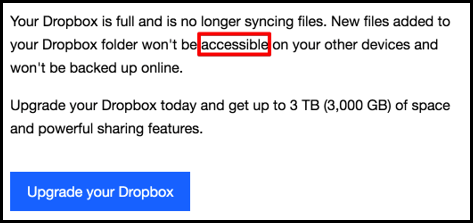
Colloquially, the term accessibility is often used to describe items or spaces that are available for use. One can expect an accessible road to be open as an option for safe, unobstructed travel for most vehicles. Here’s another example of an email from Dropbox, an online file storage tool, after a user reached the free storage limit.
In this email, the term accessible refers to availability. The user will not be able to access files because they will not be available on other devices. In both of these examples, however, the term accessible is limited to able individuals—those who are able to access material in its current form. In teaching and learning, as well as in universal design, accessible means that materials and spaces are not only available but also free from invisible barriers—even unintended ones—for anyone who needs to access those materials.
For example, an accessible text is one that is clearly organized, uses an unembellished font, and incorporates headings to separate sections. Online images should contain alternative text for moments when pages don’t load properly or for readers who use assistive devices. Videos should include closed captions or transcripts for people with hearing issues or attention/tracking problems, as well as for those who multitask (watch while exercising, for example). Even certain colloquial terms and cultural references that are used without context or explanation in a lecture or course material can function as barriers to learning.
The term accessible is evolving and currently connotes disability services and accommodations. Citing a keynote address by Andrew Lessman, a distance education lawyer, Thomas Tobin and Kirsten Behling explain why accessibility as accommodation is a problematic way to think about design: “‘accommodations are supposed to be for extraordinary circumstances'” and, paraphrasing him, added the following:
[I]t should be very rare for people to need to make specific requests for circumstances to be altered just for them [. . .] all of these environments, whether physical or virtual, should be designed so that the broadest segment of the general population will be able to interact successfully with materials and people.3
This idea applies to course design and instruction just as much as it applies to physical spaces. Practicing accessible course design and instruction is an opportunity (and a necessary imperative) to develop a pedagogy of inclusion.
Inclusion
The previous two definitions have tried to articulate the idea that students carry intersecting invisible circumstances with them into the classroom. Whether or not students disclose their circumstances—or whether faculty members invite students to disclose them—does not determine their existence. From this perspective, inclusion means designing and teaching for variability. Faculty can practice inclusive pedagogy by following universal design principles and offering multiple options for representation, engagement, and expression:
Options are essential to learning, because no single way of presenting information, no single way of responding to information, and no single way of engaging students will work across the diversity of students that populate our classrooms. Alternatives reduce barriers to learning for students with disabilities while enhancing learning opportunities for everyone.4
In a Nutshell . . .
Inclusive pedagogy can be an act of intention—something that is initiated before and during the course design process—rather than being an act of revision or omission.
Contribute to the Conversation!
Tweet your favorite inclusive design practices and resources, and be sure to tag @TLIatCI, @a11ygal, and @lgonzalez1
Thomas Tobin and Kirsten Behling, Reach Everyone, Teach Everyone: Universal Design for Learning in Higher Education (Morgantown: West Virginia University Press, 2018). ↩
Lorna Gonzalez is an Instructional Designer for Teaching and Learning Innovations and a Lecturer at California State University Channel Islands.
Kristi O’Neil is the Instructional Technologist-Accessibility Lead for Teaching and Learning Innovations at California State University Channel Islands.
The list of challenges, for disabled people and those becoming less able due to age or debilitating illnesses, seems to grow despite the innovations being developed thanks to the use of clever algorithms and increasing amounts of data and high powered computing power. This is our first attempt at publishing our ideas…
Challenges
Understanding the role and meaning Inclusion
Equity v equality
Disability is a Heterogeneous not homogeneous
Single ‘Disability’
classification not helpful as every disabled person can have very different
needs
Small data for individual
disabilities compared to big data for all (e.g. remove individuals whose data
identifiable)
Skills and Abilities rather than deficit model
Looking at what an
individual can do rather than focussing on the disabilities/difficulties
Designing for average rather than edge cases and outliers
Every disabled person may have very different needs compared to peers without a disability
Assumptions of Stakeholders
Changing attitudes
Lack of understanding – AI
and ethics, data collection, algorithms, transparency
Expectations of experts –
will have a magic wand
Eugenics issues (e.g.
Autism genetic correction)
Few disabled people involved in AI (Nothing about us without us)
Disabled people need to be
involved in AI decisions
More disabled people need
to understand AI
Capacity Issues
Resources – human,
financial, tools
Policies and Procedures
Lack of general ICT as well
as AT/AAC technologies that are regularly used in many settings
Cohesive Approach
Collaboration
AT and AAC Market
Small Market
Localisation issues
Lack of Competencies
Knowledge building
Black box non transparent Deep NN machine learning
Difficult to understand
implications of AI DNN for disabled people
Lack of interest
Disabled people’s inclusion
of little interest to Turing researchers and Turing research challenges and
programmes (lack of knowledge due to lack of undergraduate courses, PhD
supervisors, High impact Journals, Research funding etc.)
“We can only see a short distance ahead, but we can see plenty there that needs to be done.”
A. M. Turing (1950) Computing Machinery and Intelligence. Mind 49: 433-460.